Every difficult journey has a place where people stop, think, and remember who they are. The Resilience Nook (Igicumbi cy’Imbaraga Zanjye) was created to be that place. It is not just a building with paintings on the walls. It is a guided journey that helps people remember that even after pain, loss, failure, or disappointment, they still carry strength inside them.
The journey begins as soon as someone stands in front of the entrance.
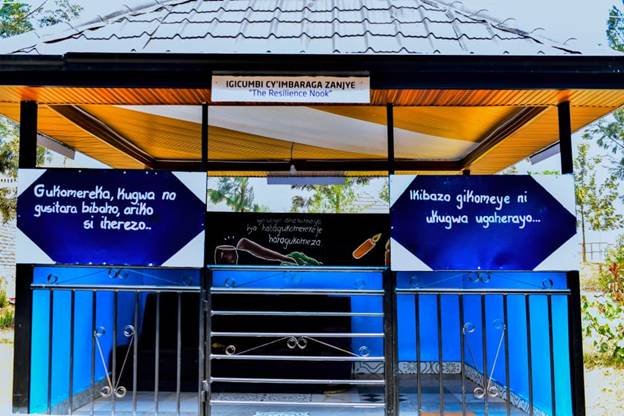
Above the entrance is the name “Igicumbi cy’Imbaraga Zanjye – The Resilience Nook.” This is an invitation. It tells every visitor, “You are entering a place where you will meet your own strength.”
On the two walls at the entrance are Kinyarwanda sayings.
One says:
“Gukomereka, kugwa no gusitara bibaho, ariko si iherezo.”
This reminds us that getting hurt, falling down, making mistakes, and experiencing pain are normal parts of life. Every person experiences them. They are not signs that life has ended. They are simply chapters in our story.
On the opposite wall is another message:
“Ikibazo si ukugwa ikibazo gikomeye ni ukugwa ugaherayo.”
The real problem is not falling. The real problem is choosing to stay where we have fallen. Pain becomes dangerous only when it convinces us that we cannot move again.
As visitors enter the Resilience Nook, they leave behind the idea that their difficulties define them. Instead, they begin a journey of discovering the strength they already have.
- What challenges, mistakes, or painful experiences have I been carrying, and what have they taught me about myself?
- Am I still standing where I fell, or am I taking steps toward healing and moving forward?
- What strengths, values, or sources of support can I rely on to help me rise again?
Difficult Times Can Reveal Hidden Strength
The first paintings remind visitors that difficult seasons are not only times of suffering. They are also times when courage appears.
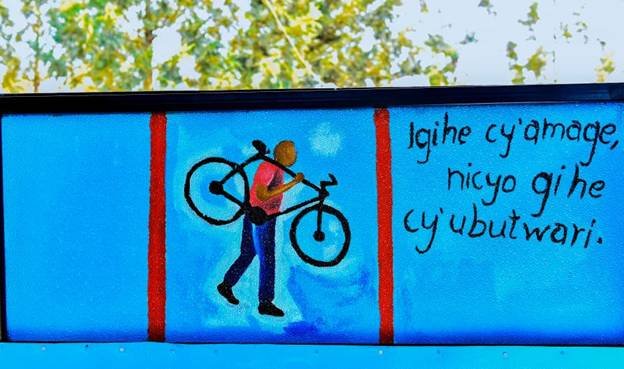
One painting shows a person carrying a bicycle with the words:
“Igihe cy’amage ni cyo gihe cy’ubutwari.”
The bicycle is no longer easy to ride. It has become heavy. The person must carry it uphill.Life can feel the same.
Sometimes we cannot continue in the usual way. We lose work. Relationships change. Illness comes. We experience grief. Our plans stop moving forward.
Instead of giving up, there are moments when we simply carry the weight one step at a time.
That is courage.
Strength is not only shown when life is easy. Often it becomes visible when life becomes difficult.
Just as Rwandans say that a person’s character appears during hardship, the Resilience Nook reminds visitors that challenges often introduce us to strengths we never knew we had.
- What “problem” am I carrying in my life right now, and how has it challenged me?
- When life became difficult, how did I respond, and what did that response reveal about my character?
- What strengths have I discovered in myself through past challenges that I did not know I possessed?
- What helps me keep moving forward, even when progress feels slow or the journey feels heavy
- How can I view my current hardship not only as a burden but also as an opportunity to grow in courage and resilience?
Everyone Has a Light Inside
Many people wait for someone else to rescue them before they begin healing.
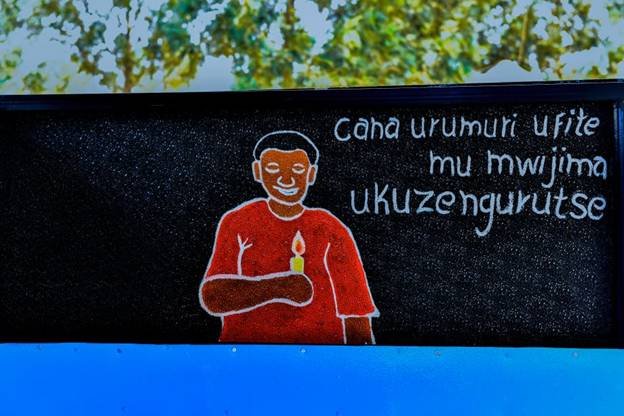
This painting offers a different message.
When life feels dark, there is still some light inside every person.It may be hope,it may be faith,it may be kindness,It may be the love of family.
It may simply be the decision to wake up tomorrow and try again.That small light matters.
- What is the “small light” in your life that has helped you keep moving forward during difficult times, and how has it influenced your journey?
- In what ways have you relied on your own inner strength, rather than waiting for someone else to rescue you, when facing challenges?
- How can you nurture and protect the hope, faith, kindness, love, or determination within yourself so it continues to guide you through life’s darkest moments?
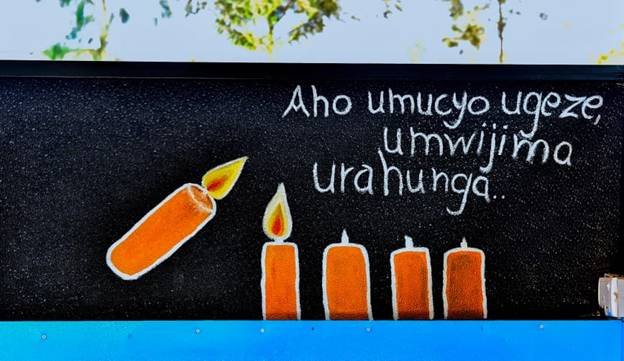
“Aho umucyo ugeze umwijima urahunga.”
Another painting shows one candle lighting several others.
The words say:
“Aho umucyo ugeze umwijima urahunga.”
Where light arrives, darkness leaves.
One small candle does not remove all darkness immediately.But One act of hope encourages another, One conversation creates another, One good decision leads to another and then Slowly the darkness loses its power.
The Resilience Nook teaches that people do not need to become perfect overnight. They only need to protect and use the small light they still have.
Hard moments Makes Us Stronger
The next painting shows a hand almost touching fire.
The message says:
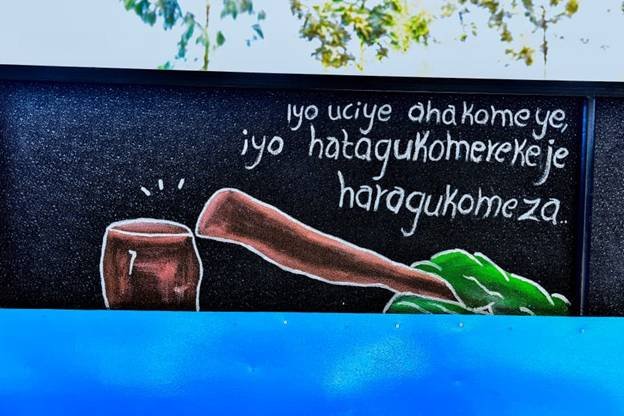
“Iyo uciye ahakomeye iyo hatagukomerekeje haragukomeza.”
If difficult moments do not destroy you, they make you stronger.
Pain changes people,Sometimes it leaves scars,Sometimes it teaches wisdom,Sometimes it builds patience, compassion, and resilience.
No one chooses suffering,but suffering can become a teacher.
The difficult road that once seemed impossible may later become the reason someone else finds hope because of your story.
The Resilience Nook does not deny pain, Instead, it asks visitors to notice what pain has already taught them.
Growth Can Begin Again
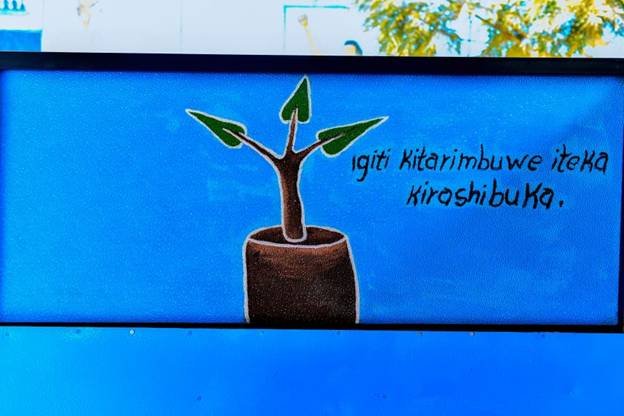
Visitors then arrive at a painting of a young tree growing again.
The words say:
“Igiti kitarimbuwe iteka kirashibuka.”
A tree that has not been completely uprooted will grow again.
Many people believe that after failure there is no future.
This painting disagrees, As long as life remains, growth remains possible.
The tree has lost branches,It may have been damaged by storms,Yet its roots remain alive.
People are similar.Loss may remove opportunities,Failure may remove confidence,Trauma may remove peace for a season.But if life remains, hope remains and growth is still possible.
One Tree Can Become a Forest
Where there is one tree, a forest can grow.
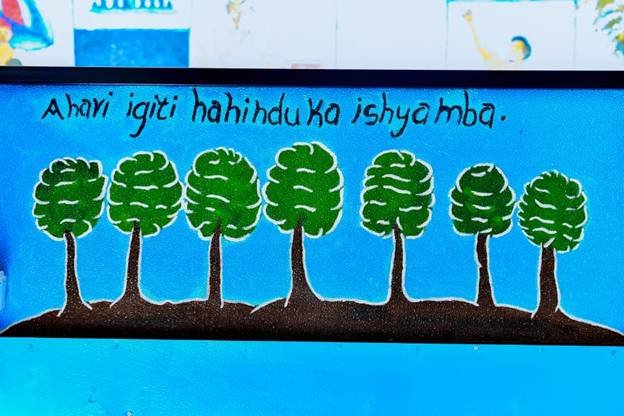
The next wall shows many trees together.
Its message says:
“Ahari igiti hahinduka ishyamba.”
Where there is one tree, a forest can grow.
Recovery rarely ends with one person.
When someone heals, families benefit.
Children benefit.
Friends benefit.
Communities benefit.
One resilient person often inspires many others.
A single act of courage can create generations of hope.
The Resilience Nook reminds visitors that their recovery is not only for themselves.
Their healing may become someone else’s beginning.
Build Again Using What Is Left
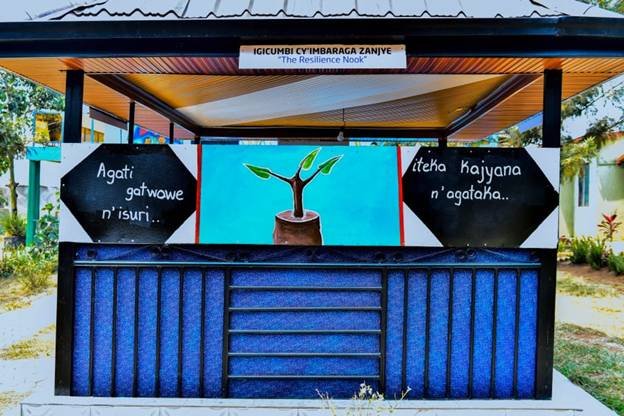
Another painting returns to the image of a small tree.
The words say:
“Agati gatwawe n’isuri kajyana iteka n’agataka.”
Even when floods carry away a tree, something small usually remains.
Storms rarely leave everything untouched.
There is almost always something left.
Perhaps knowledge.
Perhaps experience.
Perhaps one trusted friend.
Perhaps faith.
Perhaps health.
Perhaps determination.
The invitation here is simple.
Instead of focusing only on everything that has been lost, look carefully at what remains.
What is still in your hands?
What strengths survived?
What relationships survived?
What skills survived?
Those remaining pieces become the foundation for rebuilding life.
Just as a tree grows again from what remains, people can rebuild from what they still possess
You Have Already Crossed Many Bridges
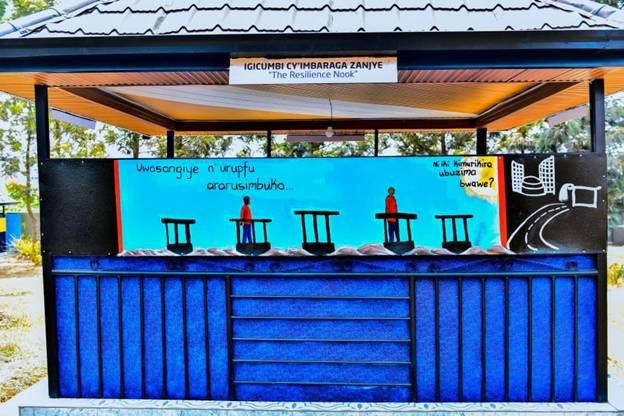
Near the end of the journey is a painting showing someone crossing several bridges.
The words remind visitors:
“Uwasangiye n’urupfu ararusimbuka.”
One who has faced death has already crossed many dangers.
Looking backward often reveals something surprising.
Many problems that once seemed impossible have already been overcome.
There were moments when giving up seemed easier.
Yet somehow the journey continued.
The bridges in the painting represent every difficult chapter already crossed.
Future bridges still exist.
But remembering previous victories gives confidence to face the next ones.
The visitor begins to realize:
“If I survived those difficult times, perhaps I can survive this one too.”
Every Night Ends
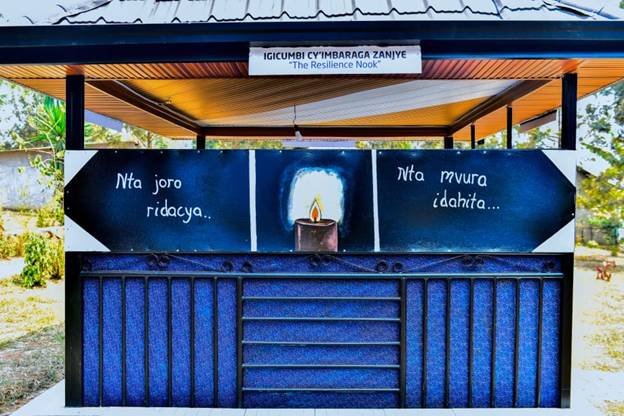
The final painting shows a candle shining brightly between two messages.
On one side:
“Nta joro ridacya.”
There is no night that never ends.
On the other:
“Nta mvura idahita.”
There is no rain that lasts forever.
These are the final lessons of the Resilience Nook.
Every painful season has an ending.
Every storm passes.
Every night eventually gives way to morning.
The visitor leaves carrying a different story.
Instead of saying,
“I am broken,”
they begin saying,
“I have survived.”
Instead of saying,
“I have nothing left,”
they begin asking,
“What still remains that I can build with?”
Instead of saying,
“My life is over,”
they begin believing,
“My next chapter is waiting.”
Leaving the Resilience Nook
Walking through the Resilience Nook is not simply viewing paintings. Every image, proverb, and reflection builds on the one before it.
The journey begins by accepting that pain is part of life but not the end of life. It continues by discovering the courage hidden inside difficult moments, protecting the small light that remains, learning from hardship, growing again like a living tree, rebuilding from what survives, remembering past victories, and finally believing that every night will eventually become morning.
The Resilience Nook invites every visitor to leave with one simple truth:
Your difficulties are real, but they are not your identity. The strength you need to continue already lives within you. Every step you take, every lesson you learn, and every challenge you overcome adds to that strength. One day, what began as a small light inside you may become a forest of hope for many others.
Discover with Dr. Chaste UWIHOREYE Your Inner Strength: A Journey Through Life’s Bridges and Hardships
This time, we are on a journey to look at how a person sees the inner strength they possess recognizing that they have power, extraordinary power, which can enable them to confront and handle challenges and difficulties.
Reflecting on Your Life’s Journey
I am going to ask you once again to take a moment to reflect, to think back on your life’s journey, looking as far back as possible into your early years—when you were two, three, four, ten, fifteen, or twenty years old, all the way up to your current age.
As you reflect on that life journey, you will find that you have leaped over major obstacles, you will see that you have encountered difficulties, and you will see that there were times when you reached a point where a bridge was broken, leaving you asking for help in the darkness, encountering those who made things hard for you, and facing things that broke you down. Yet, you will find that you managed to step out of them little by little. Think about that journey you walked through, and think of the bridges you built for your life.
- Have you ever reached a point where you felt life had come to a standstill, yet the bridge was built and you kept moving?
- Have you ever reached a point where you were in the dark, but were able to find the light?
They say in Kinyarwanda that when it is high up in the darkness, the darkness flees. At that time, how did you manage to jump over those things? Was it strength you dug up from within yourself, or was it people who helped you?
Building the Path of Your Life
Try to build that circle or path of your life:
- Look at the bridges you built along the way, and look at what they were constructed from.
- If you want, sketch them, or give those structures names.
- These names represent the inner strengths you stored within yourself. Some might call it perseverance or resilience.
- Have you ever reached a point of fighting through, where resilience allowed you to find the light?
- Have you encountered a situation where a bridge was broken, but your refusal to give up enabled you to keep going?
Sketch that circle of bridges you built in your life while facing hardships, and when you finish, give them different names.
A Letter of Appreciation to Your Strength
If possible, take a moment to write a letter to those bridges of yours:
- Write a letter of appreciation—thanking them for coming into your life and being glad that you have them.
- Once you finish, read that letter over and over again, once, twice, and reflect on the strength that allowed you to find the light where others saw only darkness.
- Think about how that strength enabled you to build your life and keep moving forward, and consider how you can apply those same strengths in your current life, especially during difficult times or in your future.
Walk with Dr. Chaste UWIHOREYE through the Journey of Finding Strength in Hardship: Building on What Remains
When facing difficulties, it is easy to become overwhelmed by life’s challenges. Often, a person in trouble only sees the hardship, missing the inner strengths, survival mechanisms, and hidden reservoirs of power that keep them moving forward. However, as long as breathing continues, there are underlying reasons for existence—reasons for standing, breathing, speaking, eating, and healing.
1. Identifying What Remains After the Flood
In Kinyarwanda culture, it is said that a tree resisting a flood always holds tightly to its soil. Similarly, when troubles sweep through life like a destructive flood, it is essential to examine what soil—and what strengths—were left behind.
Consider the following elements that may have endured your personal storms:
- Relationships and Community: Remaining connections with parents, family, or supportive friends.
- Structure and Purpose: The continuation of school, work, or specific meaningful activities.
- Resilience Factors: Even when swept into heavy problems, foundational parts of life often stay intact to serve as a base for recovery.
2. Nurturing Your Inner Growth
A tree carried away by a flood can grow back, sprout new leaves, and bear fruit if it is watered again. No matter how small or large your remaining resources may seem, they hold immense value.
By identifying these remaining anchors—whether they are rooted in personal skills, professional stability, or familial support—you can water them, regain your strength, and rebuild.
3. Cultivating Resilience for the Future
Reflecting on what survived your hardships allows you to step forward with renewed purpose:
- For children and youth: Cultivating the strength to win and the vision of a bright future.
- For parents and adults: Realizing that homes, work, and personal foundations can be nurtured back to wellness.
The soil of your resilience is still there, ready to support you as you move forward.
The Umbrella of Resilience: How to Stand Strong Amidst Life’s Storms
Actually, when a person encounters problems, they often forget that they have things giving them strength. I am going to ask you to think again, to think about the many life problems you have, whether they are historical, family-related, physical, illnesses, hardships, poverty, unemployment, and all those things are problems surrounding you. But you will find that you are still standing.
Understanding the Umbrella of Your Problems
Think about an umbrella, then:
- An umbrella is a tool that protects us from the rain when it is about to drench us.
- It is also a tool that protects us from the sun when it scorches us.
Think about the umbrella of your problems: what is the umbrella of your problems made of, what will your pillars be made of, and what will your fabric be made of, so that when problems fall on it, they slide off without you getting drenched or rotting?
Visualizing Your Shield Against Hardship
If you want, picture yourself under the umbrella, and above the umbrella put all the problems that are falling on you:
- The stresses that are keeping you from sleeping.
- The hardships that are making you suffer and think too much.
- The pain and struggles that are hurting you—put them all on top of the umbrella.
When you finish, think about how you would use that umbrella, how you would use it. There are people who have an umbrella and don’t open it over themselves, which makes them get drenched, and makes the sun beat down on them.
Think about how you could use the problems that make up the umbrella to continue your life, even if your problems are still there, or even if there comes a time when you take the umbrella away.