“A person is the expert of his/her own life.”
Step One: Be brave enough to know yourself.
When people visit the Self-Assessment Harbor at Serenity Wellness Oasis (Iriba ry’Ubuzima), they are invited to begin a journey. It is not a journey to another country or another city. It is a journey into themselves.
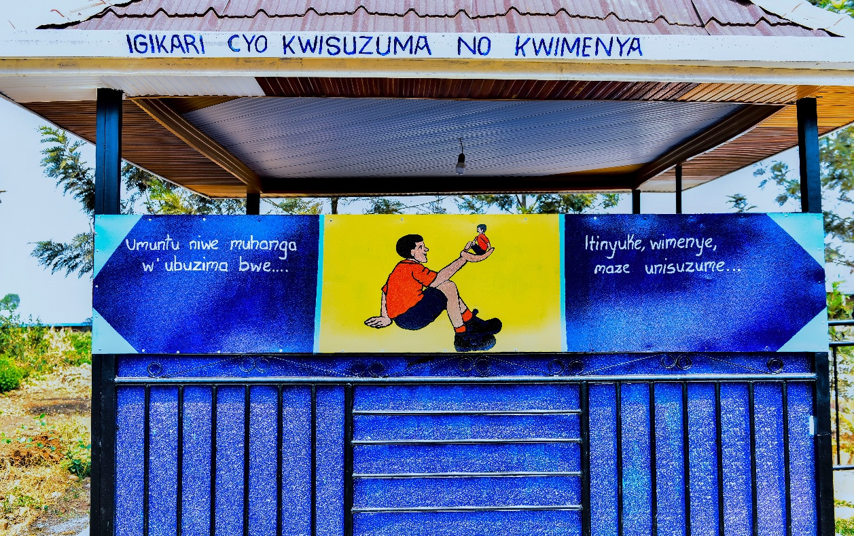
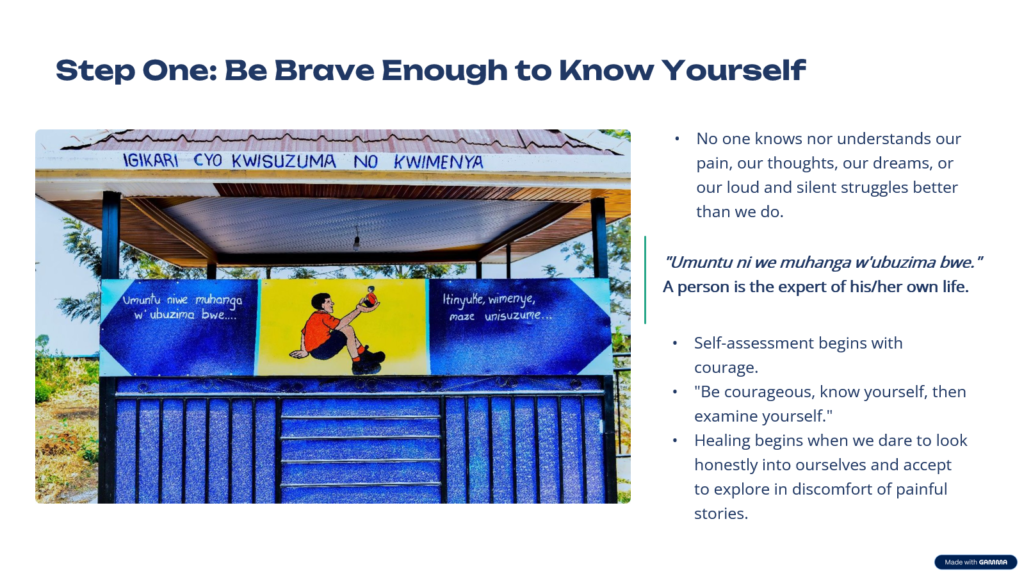
This special space teaches that every person should take time alone, introspect themselves and understand their own life. No one knows nor understands our pain, our thoughts, our dreams, or our loud and silent struggles better than we do. That is why the journey starts with courage. In Kinyarwanda, there is a saying:
“Umuntu ni we muhanga w’ubuzima bwe.”
A person is the expert of his/her own life.
The paintings around the space guide visitors through this journey, one step at a time.
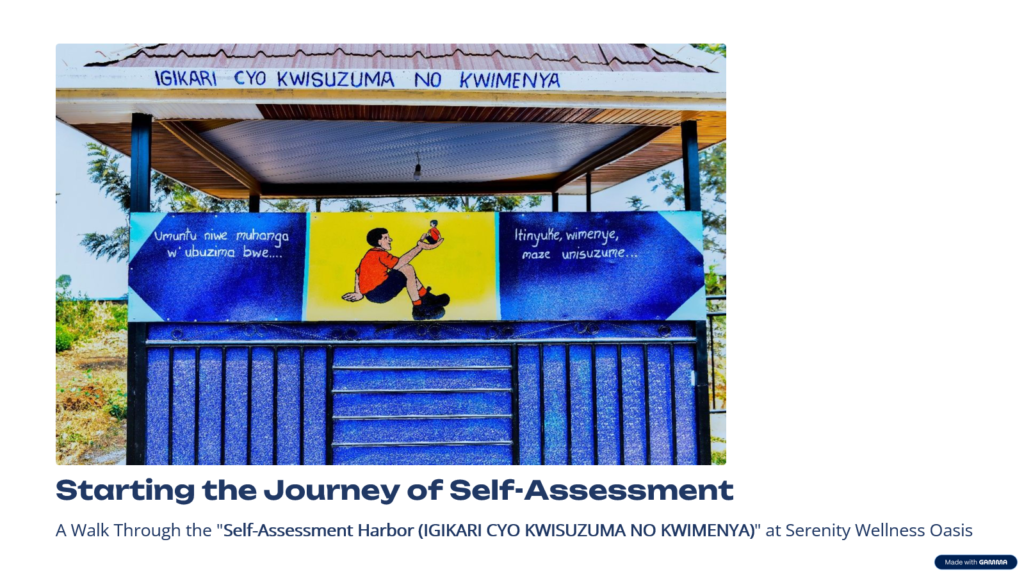
The first painting shows a person carefully holding a smaller version of themselves in their hand. It reminds us that we must first become friends with ourselves.
“Be courageous, know yourself, then examine yourself.”
Self-assessment begins with courage. Many people spend their lives understanding everyone else while avoiding their own story. But healing begins when we dare to look honestly into ourselves, and accept to explore in discomfort of painful stories.
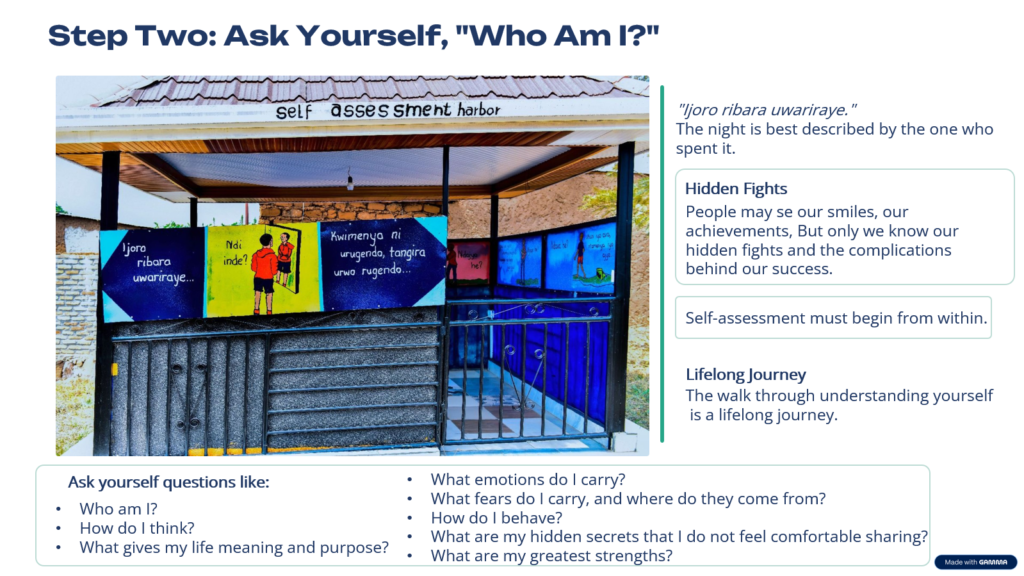
Step Two: Ask Yourself, "Who Am I?"
Another Kinyarwanda proverb says:
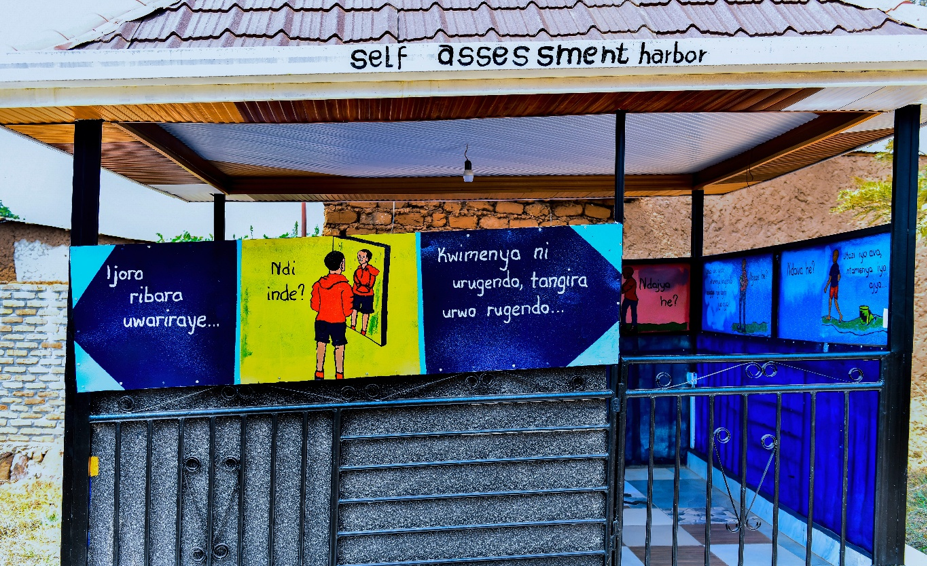
“Ijoro ribara uwariraye.”
The night is best described by the one who spent it.
People may see our smile, but only we know our hidden fights. Others may see our success, but only we know the complications and hardships behind it. That is why self-assessment must begin from within.
The next painting shows someone standing in front of a mirror asking,
“Ndi nde?” – “Who am I?”
The walk through the path of understanding yourself is not completed in one day. It is a lifelong journey.
The Space invites every visitor to ask simple but important questions:
- Who am I?
- How do I think?
- What gives my life meaning and purpose?
- What emotions do I carry?
- What fears do I carry, and where do they come from?
- How do I behave?
- What are my hidden secrets that I do not feel comfortable sharing?
- What are my greatest strengths?
- What kind of person am I becoming?
These questions are not meant to make us feel judged. They help us become aware of ourselves. Before changing anything in life, we must first understand where we are standing.
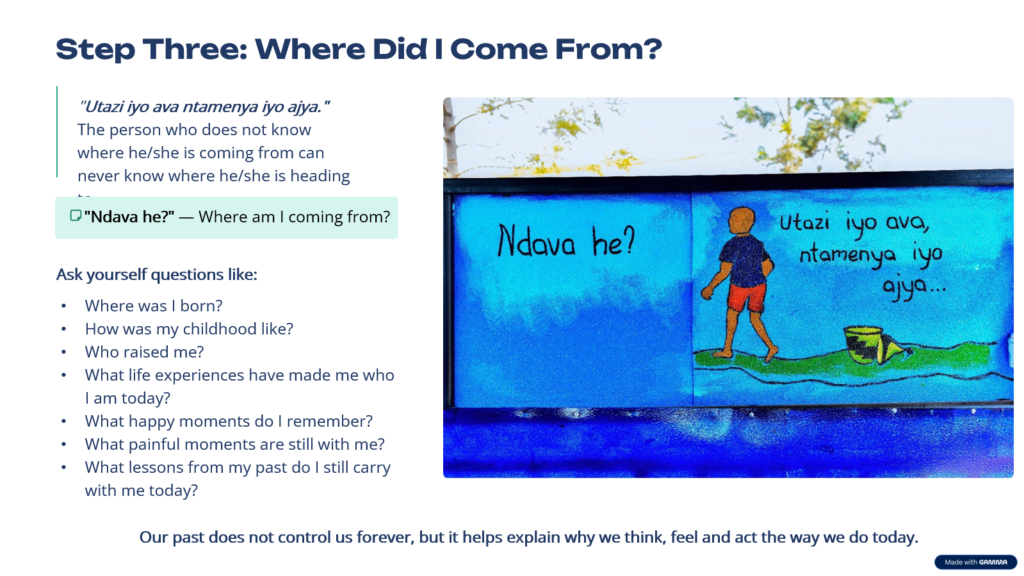
Step Three: Look back and ask yourself, "Where did i come from?"
The next section asks another important question:
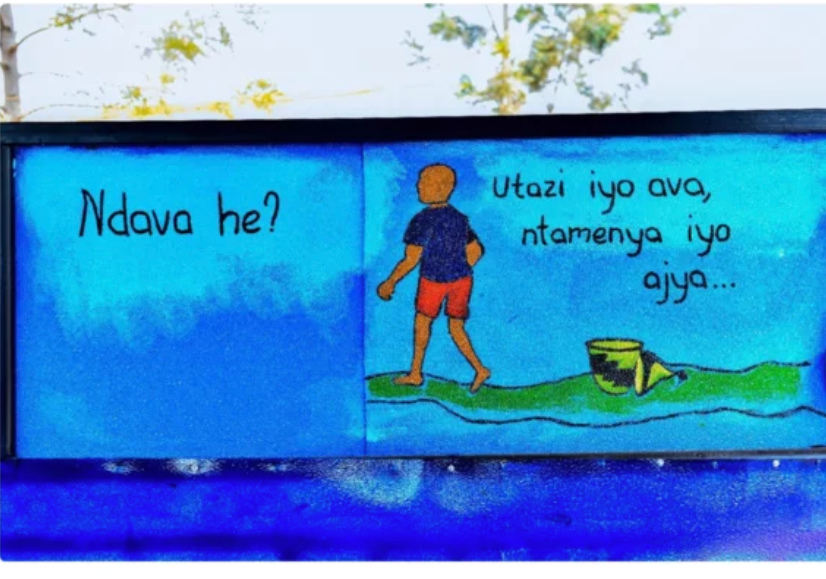
“Ndava he?” – “Where am I coming from?”
This special space encourages visitors to reflect about their own history.
Think about:
- Where was I born?
- How was my childhood like?
- Who raised me?
- What life experiences have made me who I am today?
- What happy moments do I remember?
- What painful moments are still with me?
- What lessons from my past do I still carry with me today?
There is another Kinyarwanda saying:
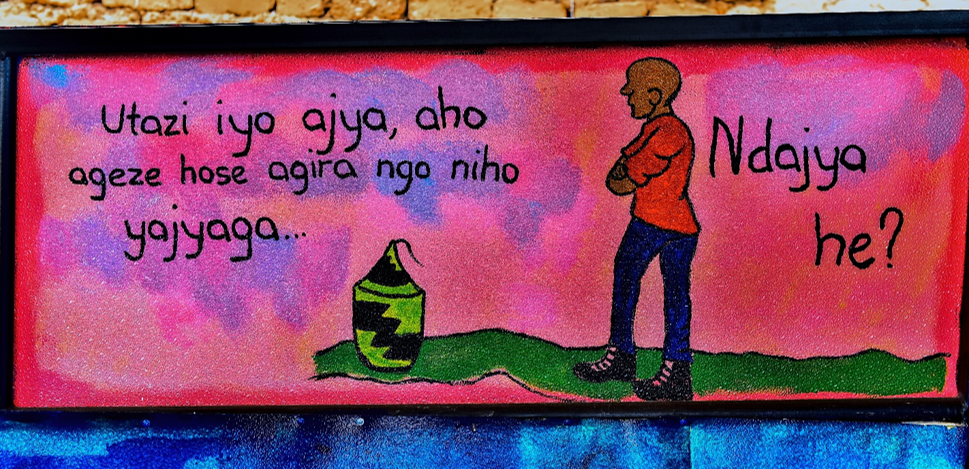
“Utazi iyo ava ntamenya iyo ajya.”
The person who does not know where he/she is coming from can never know where he/she is heading to.
Our past does not control us forever, but it helps explain why we think, feel and act the way we do today.
Our past does not control us forever, but it helps explain why we think, feel and act the way we do today.
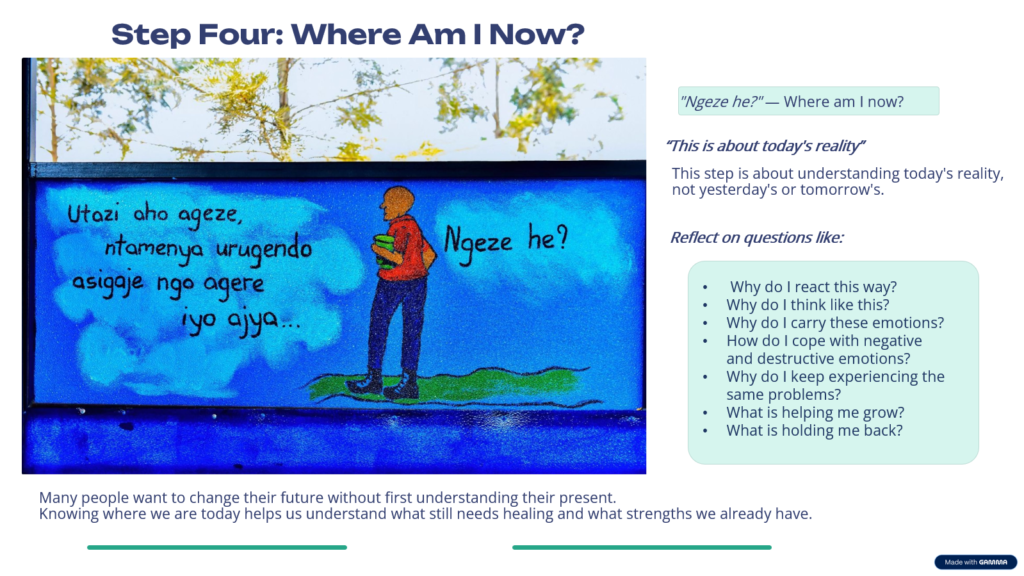
Step Four: Ask Yourself, "Where Am I Now?"
After understanding the past, visitors are invited to ask:
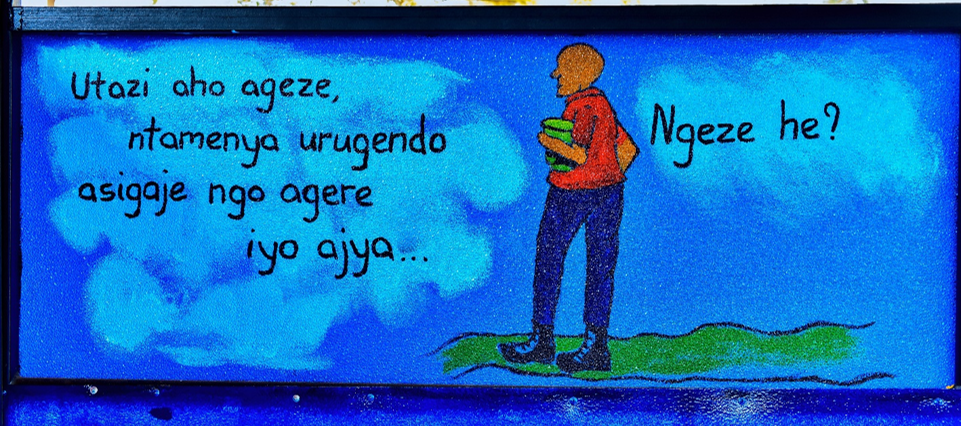
“Ngeze he?” – “Where am I now?”
This is about today’s reality.
This special space encourages people to ask themselves:
- Why do I react this way?
- Why do I think like this?
- Why do I carry these emotions?
- How do I cope with negative and destructive emotions?
- Why do I keep experiencing the same problems?
- What is helping me grow?
- What is holding me back?
Many people want to change their future without first understanding their present.
Knowing where we are today helps us understand what still needs healing and what strengths we already have.
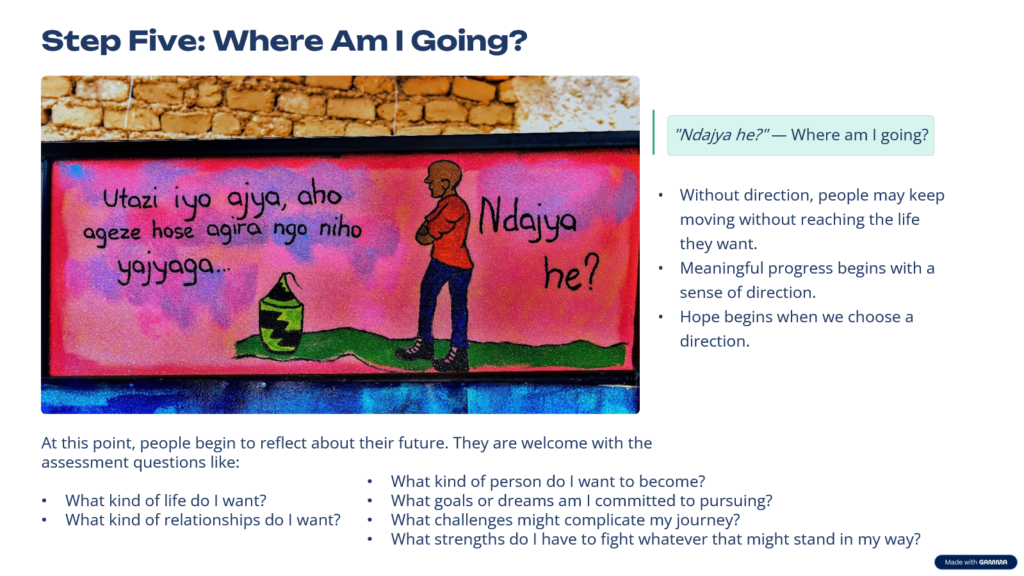
Step Five: Ask, "Where am I going?"
The next painting asks:
“Ndajya he?” – “Where am I going?”
Without direction, people may keep moving without reaching the life they want. This space reminds visitors that meaningful progress begins with a sense of direction; when we do not know where we want to go, every road can appear correct.
At this point, people begin to reflect about their future. They are welcome with the assessment questions like:
- What kind of life do I want?
- What kind of relationships do I want?
- What kind of person do I want to become?
- What goals or dreams am I committed to pursuing?
- What challenges might complicate my journey?
- What strengths do I have to fight whatever that might stand in my way?
Hope begins when we choose a direction.
Step Six: Am I going in circles?
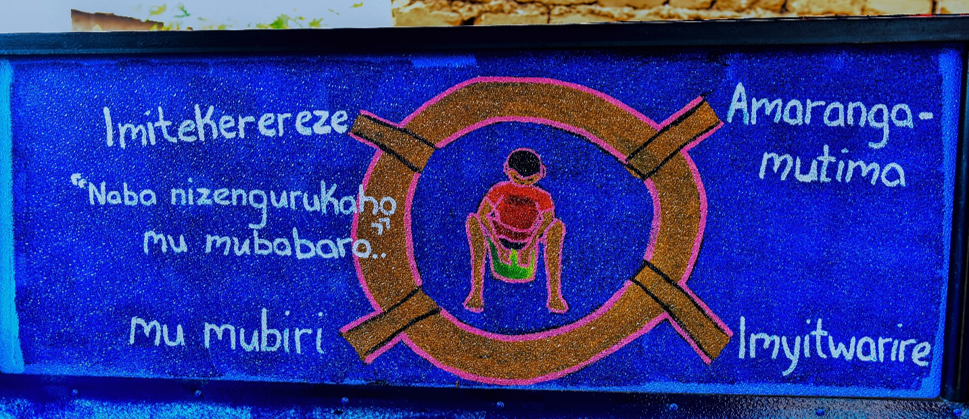
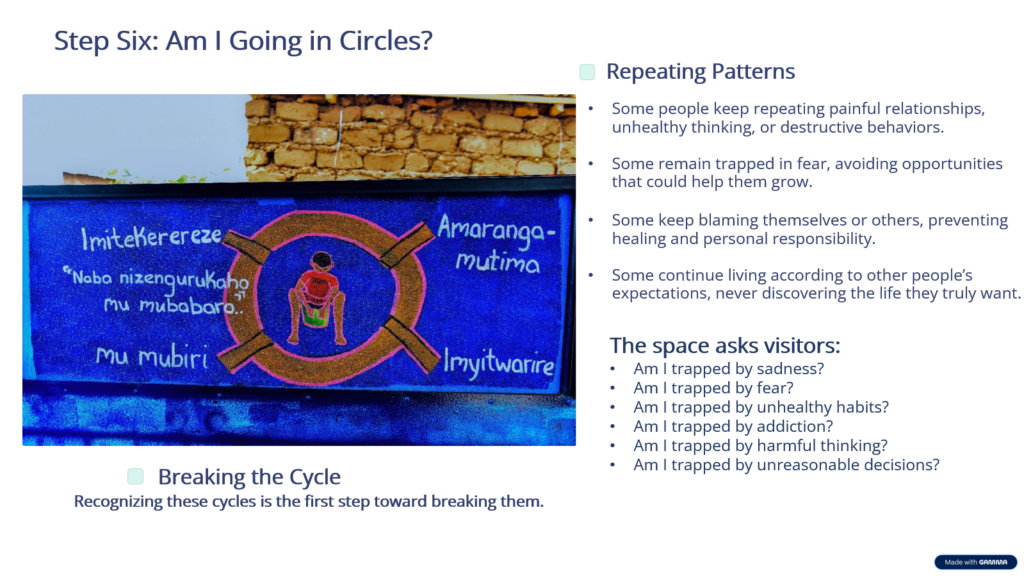
Other painting shows a person trapped inside a circle.
The question is:
Am I going around in circles?
Sometimes life feels busy, but nothing changes.
Some people keep repeating painful relationships.
Some repeat unhealthy thinking.
Some repeat destructive behaviors.
Some remain trapped in fear, avoiding opportunities that could help them grow.
Some keep blaming themselves or others, preventing healing and personal responsibility.
Some continue living according to other people’s expectations, never discovering the life they truly want.
Others use alcohol or drugs to escape emotional pain, only to create even more suffering.
Instead of moving forward, they keep returning to the same place.
The space asks visitors:
- Am I trapped by sadness?
- Am I trapped by fear?
- Am I trapped by unhealthy habits?
- Am I trapped by addiction?
- Am I trapped by harmful thinking?
- Am I trapped by unreasonable decisions?
Recognizing these cycles is the first step toward breaking them.
Step Seven: Name Your Problem
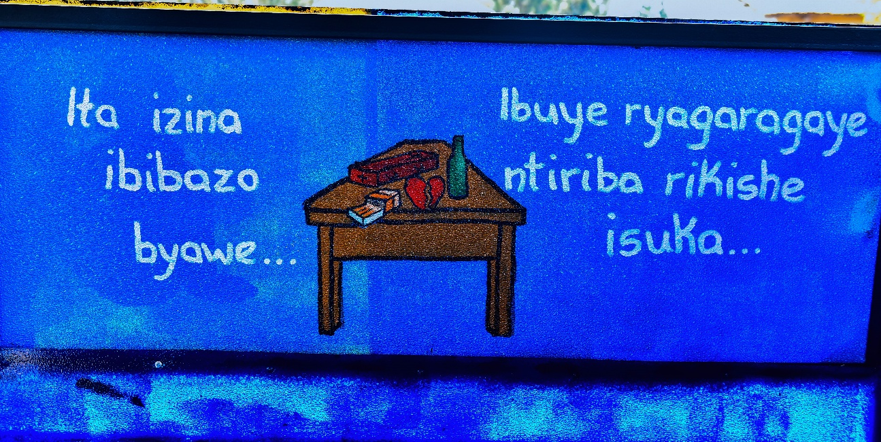
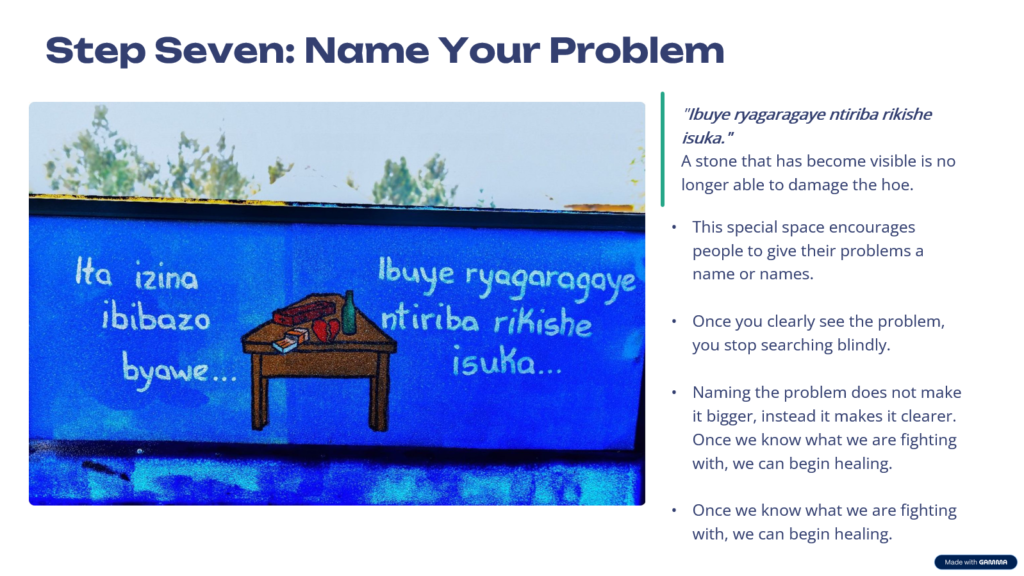
The next painting shows a table with different objects and this one also holds a message.
“Ibuye ryagaragaye ntiriba rikishe isuka.”
A stone that has become visible is no longer able to damage the hoe.
Once you clearly see the problem, you stop searching blindly.
This special space encourages people to give their problems a name or names.
If your struggle had a name, what would it be?
Some people say:
- Fear
- Grief
- Loneliness
- Anger
- Addiction
- Trauma
- Shame
- Depression
- Darkness
- Dangerous Animal
- Unwelcomed visitor
- Etc.…
Naming the problem does not make it bigger, instead it makes it clearer. Once we know what we are fighting with, we can begin healing.
Step Eight: Remember that “Your story is bigger than your problems”
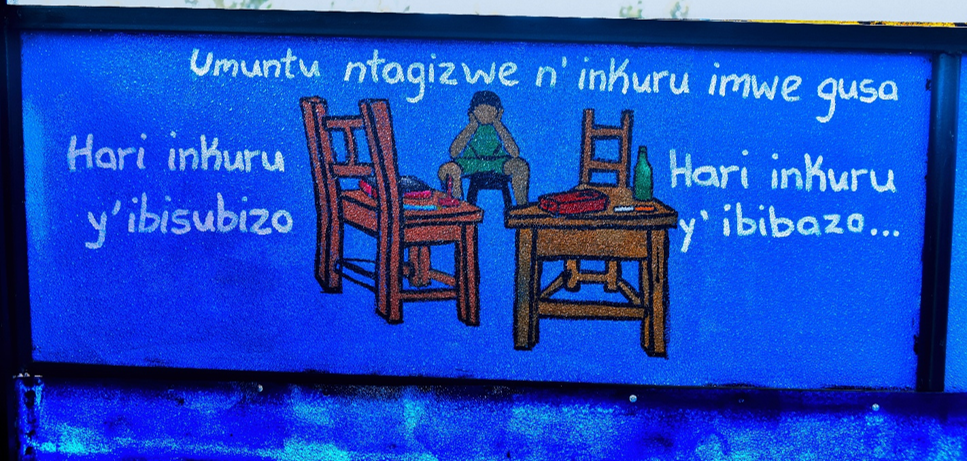
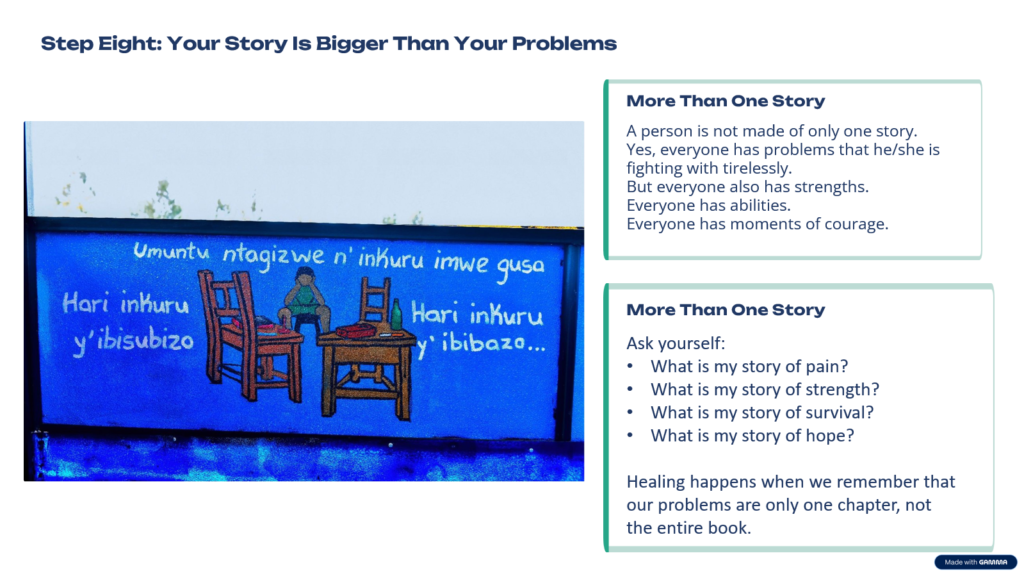
Another painting shows two chairs and reminds visitors of an important truth.
A person is not made of only one story.
Yes, everyone has problems that he/she is fighting with tirelessly.
But everyone also has strengths.
Everyone has abilities.
Everyone has moments of courage.
Everyone has hope.
The space invites people to explore every part of their life story.
Ask yourself:
- What is my story of pain?
- What is my story of strength?
- What is my story of survival?
- What is my story of hope?
Healing happens when we remember that our problems are only one chapter, not the entire book.
Step Nine: Many Roads Are Before You
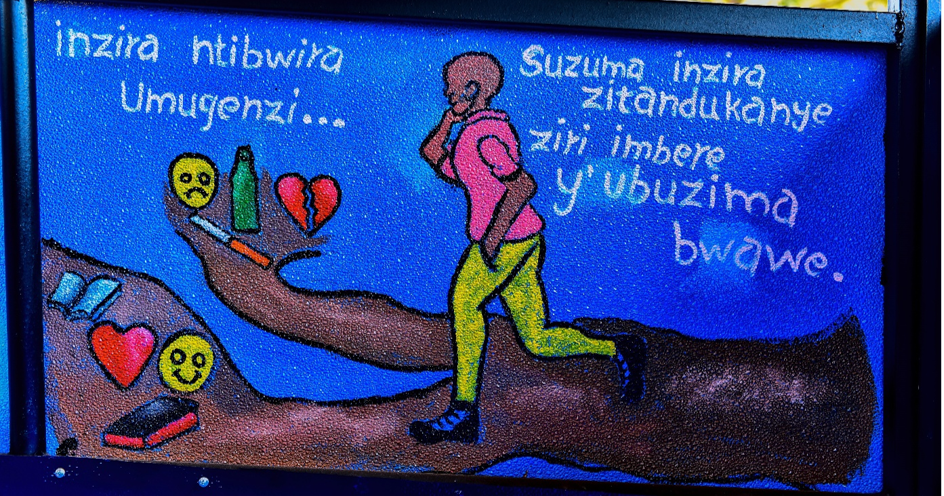
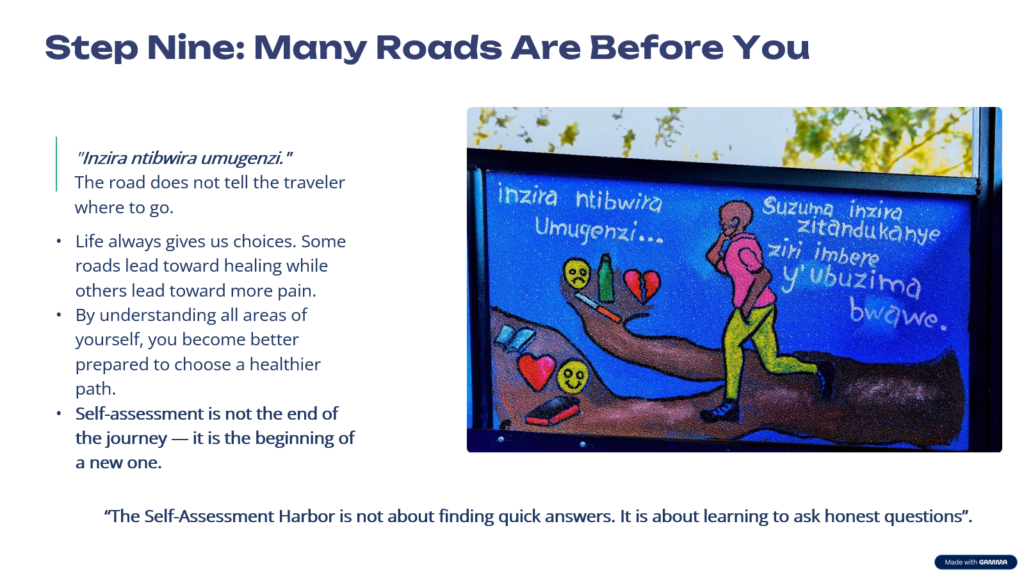
The final painting shows different symbols representing different life paths.
Its message says:
“Inzira ntibwira umugenzi.”
“The road does not tell the traveler where to go.”
Life always gives us choices.
Some roads lead toward healing while others lead toward more pain.
The space encourages visitors to carefully examine every part of themselves before choosing their next step.
They are invited to look at:
- Their thoughts.
- Their emotions.
- Their body.
- Their behaviors.
- Their relationships.
- Their environment.
- Their beliefs.
- Their temperaments.
- Their strengths and weaknesses.
By understanding all these areas, visitors become better prepared to choose a healthier path.
A journey that begins with one honest step.
The Self-Assessment Harbor is not about finding quick answers. It is about learning to ask honest questions.
Visitors begin by knowing themselves.
They explore where they came from.
They understand where they are today.
They decide where they want to go.
They identify repeating cycles.
They name their struggles.
They recognize their strengths.
Finally, they choose the path they want to follow.
This journey reminds us that healing begins with awareness. Before changing our lives, we must first understand our lives. As the Harbor teaches, every person carries both pain and strength. When we courageously examine ourselves, we become better able to build a future filled with purpose, resilience, and hope.
Self-assessment is not the end of the journey it is the beginning of a new one.
Start your Self-Assessment Journey here Step by Step
Watch the Video of self assessment
Walk with Dr. Chaste Uwihoreye on the journey of Confronting Our Past: A Practical Guide to Emotional Healing and Self-Reflection
Embarking on the journey of emotional healing requires courage, patience, and a willingness to look inward. Mental wellness is not built overnight; rather, it is forged through a continuous process of confronting our difficulties, processing past pain, and untangling the complex thoughts that affect our daily lives.
Step 1: Reflecting on Your Life’s Journey
True healing begins when we take the time to look back. By examining the life you have lived—from early childhood milestones at ages five, ten, and fifteen, up to your present day you can begin to map out your hardships. Reflect closely on how these challenges manifested:
- Mental Impact: How did they alter your thoughts and internal dialogue?
- Emotional Impact: What feelings or emotional cycles were triggered?
- Physical Toll: How did your body respond to stress and past trauma?
Step 2: The Empty Chair Exercise
Often, our burdens and emotional entanglements feel like external forces or separate entities weighing us down. To process this, try a powerful psychological and reflective exercise:
- Set Up the Chairs: Take a seat in one chair, and place an empty chair directly in front of you.
- Assign the Burden: Visualize the specific problem, pain, or repeating cycle you face, and place it onto that empty chair.
- Dialogue: Begin speaking directly to it. Ask what it wants from you, and clearly state what you expect or need in return.
Step 3: Personifying and Writing It Out
Writing serves as a profound tool for release. If your pain or hardship were to take shape as a physical creature, try to personify it. Put it down on paper explain it clearly, draw it, and articulate what it brought into your life.
Once you have written down your thoughts and observations:
- Read and Repeat: Take the time to read through what you’ve written. Read it again, and repeat the process as many times as necessary to process the emotions fully.
- Release: By giving shape to your struggles and addressing them directly, you take the first vital step toward dismantling the pain and reclaiming your inner peace.
Walk with Dr. Chaste Uwihoreye on the journey of Breaking the Cycle: Understanding and Overcoming the Loop of Pain and Addiction
Trapped in the Loop of “Circling Around in Pain”
Life often presents us with heavy burdens; ranging from family struggles to past history; that leave deep emotional scars. For many, these unresolved wounds can push them toward coping mechanisms like alcohol or substance use, searching for a way to numb the hurt.
In a reflective message by Chaste Uwihoreye, this pattern is described as “circling around in pain”—a repetitive loop where individuals attempt to heal their suffering through substances, only to find the weight becoming even heavier.
Key Takeaways from Dr. Chaste Uwihoreye’s Reflection
- The Root of the Struggle: Substance use and addiction rarely start in a vacuum; they often stem from underlying emotional pain, family difficulties, or past trauma.
- The Illusion of Relief: While alcohol or drugs may initially feel like a way to self-medicate or reduce suffering, they ultimately compound the pain, bringing added sorrow, despair, and disruption to one’s career, education, and daily life.
- The Escalation of the Cycle: Over time, the loop can intensify to the point where it impacts personal possessions, integrity, and relationships, leading individuals into behaviors they never thought they would commit.
- The Power of Self-Reflection: Healing begins when a person is willing to pause, look inward, and map out how the cycle started acknowledging the triggers, the missteps, and the ongoing impact.
- A Path Toward True Renewal: While setbacks and self-disappointment are common along the journey of quitting, recognizing the cycle clearly is the first crucial step toward breaking free and reclaiming one’s life.
Stepping Out of the Darkness
Overcoming addiction and the cycle of pain requires courage, honesty, and a willingness to confront the past. By sketching out and visualizing how these patterns operate, individuals can begin their true journey of healing, leaving behind the destructive loop to find lasting inner peace.
Watch this video of Dr. Chaste Uwihoreye explaining more about : “Breaking the Cycle: Understanding and Overcoming the Loop of Pain and Addiction.”
Separating Yourself from Your Problems: A Journey Toward Healing with Dr. Chaste Uwihoreye
Welcome back to our ongoing journey of confronting life’s challenges. In our previous discussions, we explored a fundamental truth about hardships: you and your problems are entirely separate entities.
You were not born with your struggles, and more often than not, you played no active role in bringing them into your life. We also looked at the unique therapeutic approach of writing a letter to your problem—sometimes thanking it for the lessons it brought, seeking explanations, or establishing boundaries to finally say goodbye.
Now, it is time to take the next step forward.
Envisioning a New Life Beyond Your Struggles
Ask yourself this critical question: If the problem that has been constantly revolving around you were to leave your life today, what would take its place?
If your recent days have been filled with darkness, emotional burdens, or the sharp “thorns” of life pricking at your peace, imagine those elements completely gone. What fills that newly opened space?
Step-by-Step Exercise for Reflection:
- Pause and Reflect: Sit comfortably in a quiet space, close your eyes, and deeply consider how it will feel when this weight is no longer inside you.
- Visualize the Replacement: Picture what enters your life to replace the pain. Imagine placing this new, positive presence right in front of you—perhaps on an empty chair or table—and examine it clearly.
- Write Your Letter: Compose a detailed letter to this new chapter or to the experience. Whether you choose to reflect deeply, invite positive change into your space, or firmly establish your boundaries, let your thoughts flow freely onto the page. Don’t hesitate to write multiple drafts if it helps you process your emotions.
Looking Confidently Toward the Future
Take time to observe how your heart, your mind, and your physical body respond when you envision life without this burden.
When we carry unresolved pain without examining the alternative, we often wander blindly, mistaking our stumbling steps for a true path. By consciously defining what we want our future to look like, we stop moving aimlessly and start walking with purpose.
Let’s look forward to our future together. Thank you for walking this path of healing.
Watch this video of Dr. Chaste Uwihoreye explaining more about : “Separating Yourself from Your Problems”
Navigating Grief: Healing Through Connection and Letter-Writing with Dr. Chaste Uwihoreye
Welcome back to our ongoing journey of confronting life’s hardships and overcoming the heavy problems we encounter along the way. For many of us, this journey intersects with profound emotional, psychological, or behavioral pain caused by the loss of a loved one.
Losing someone is a devastating experience—whether it is a sibling, a parent, a friend, a sudden departure without a final goodbye, a severe illness, or a tragic accident. There are countless ways we grieve, but the weight of that absence can often feel overwhelming.
The Two-Chair Exercise: Bridging the Distance
If you are currently carrying the deep pain of losing someone significant in your life—whether they have passed away or are simply no longer by your side—there is a gentle, therapeutic practice you can try.
Step-by-Step Guide to the Practice:
- Identify Someone Significant: Think of a parent, child, friend, or colleague who holds a deeply meaningful place in your life.
- Set Up Your Space: Use a simple two-chair exercise. Sit comfortably in your own chair, and visualize an empty chair placed across from you.
- Seat Them Visually: Picture that significant person sitting right there in the empty chair. Look at them and allow yourself to remember them fully.
- Speak Your Mind: Talk to them as if they were right there. Ask them the questions you never got to ask, and share whatever news or thoughts are currently sitting on your heart.
Writing the Letter: Finding Peace in Expression
Sometimes, speaking out loud is only the first step. To deepen your healing, take a moment to write a detailed, heartfelt letter to them.
- Pour Out Your Thoughts: Greet them, ask your questions, share your updates, and let your emotions flow freely onto the page without judgment.
- Read and Reflect: Once finished, take time to read the letter over a couple of times. Notice how the words bring clarity and comfort to your spirit.
- Keep It Safe: Store the letter somewhere safe and meaningful. You can return to read it whenever you need to feel that connection again.
Living in Harmony with Your Memories
This practice is designed to help you coexist peacefully with the memory of your loved one—whether they are physically with you or gone. It helps ease the lingering pain, smoothing out the difficult edges of how they left or how your relationship changed, so you can move forward without unnecessary suffering.
Thank you for walking this path of healing and self-discovery with us.
Watch this video of Dr. Chaste Uwihoreye explaining more about : Navigating Grief: Healing Through Connection and Letter-Writing
Continue to the Second Healing Kit From Past Experiences ” Facing our Problem”
This is the next step in your journey. After understanding yourself, you begin to face what is difficult in your life.